
Bulletin of Dental Education Article
Archive
Dr. Adepitan Owosho Leads Dental Oncology Care and Research at A.T. Still University Missouri School of Dentistry & Oral Health
Adepitan Owosho, B.Ch.D., (D)ABOMP, (F)AAOMP, (F)AAOM, FAMeds, A.T. Still University Professor of Oral and Maxillofacial Pathology and Oral Medicine, serves as the Specialty Care Unit Director for Oral Medicine, Dental Oncology and Urgent Care at A.T. Still University Missouri School of Dentistry & Oral Health (ATSU-MOSDOH) and the St. Louis Dental Center in St. Louis, MO.
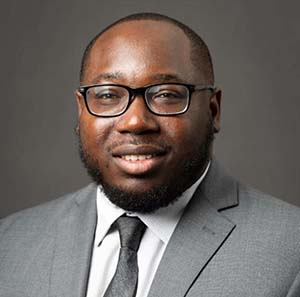
(F)AAOMP, (F)AAOM, FAMeds
At the St. Louis Dental Center, a federally qualified health center operated in partnership between ATSU and Affinia Healthcare, Dr. Owosho oversees third- and fourth-year dental students who connect with patients coming for oral health care and urgent care services. The students are supervised by Dr. Owosho and his team as they help to examine, diagnose and treat patients.
Dr. Owosho serves as the dental oncologist for the Washington University/Barnes-Jewish Hospital Department of Otolaryngology and SSM Saint Louis University Hospital of St. Louis. Patients are referred for dental clearance prior to oncologic therapy, which comprises comprehensive dental examination and management of oral conditions in preparation for chemoradiation, stem cell transplant and antiresorptive medication use. The clinic also manages potential oral adverse events from these oncologic therapies.
With his oversight, approximately 200 new oncology patients with head and neck and hematologic cancers are seen in the dental center each year, providing educational and clinical experiences for ATSU-MOSDOH dental students.
An academic clinician, oral diagnostic expert and dental oncologist, Dr. Owosho integrates patient‑centered care, translational research and academic leadership in his work. With advanced training in dentistry, oral pathology and oncology, he established a distinguished career marked by clinical excellence, scholarly impact and a strong commitment to mentorship and health equity.
“This is one of the few programs in the country where predoctoral dental students are directly involved in the care of oncology patients who need dental clearance for oncologic therapy,” said Dr. Owosho. “Every Thursday, this clinic sees four to eight patients a day to assess their progress before they can be released for oncologic care.”
“At one time, I was kind of negligent about my mouth and teeth,” admitted a 63-year-old male who was diagnosed in 2022 with salivary gland cancer and treated in the Head and Neck Tumor Center at Siteman Cancer Center at the Washington University School of Medicine. He now schedules an appointment with Dr. Owosho every three months for a teeth cleaning and evaluation. “Having struggled with the cancer treatment, I am now in a head and neck support group and continually reminded how important it is to have regular dental exams. I now consider this my dental home.”
Dr. Owosho’s clinical practice focuses on the diagnosis and management of complex oral diseases, including oral potentially malignant disorders (OPMDs), autoimmune mucosal conditions and oral complications arising from cancer therapy. In dental oncology, he is a valued consultant to multidisciplinary cancer teams, particularly in head and neck oncology, where he contributes to improving patient survivorship and quality of life during chemotherapy, radiotherapy and targeted treatments.
Dr. Owosho’s research portfolio includes influential studies at the intersection of oral medicine, oncology and systemic disease. His work spans medication‑related osteonecrosis of the jaw, salivary gland dysfunction, oral toxicities of systemic therapies and the epidemiology of oral lesions across diverse populations. Widely cited and clinically relevant, his scholarship reflects a dedication to generating evidence that advances practice and enhances patient care.
The research is ongoing and includes Dr. Owosho’s participation in the studyValidity of Viome’s Oral/Oropharyngeal Cancer Test Among Patients with a Suspicion of Cancer. The study started in February 2025 and is anticipated to conclude in February 2027.
This is a prospective, multicenter study currently enrolling patients with oral and oropharyngeal cancers from primary and secondary care centers across the United States. The primary objective is to develop a saliva-based diagnostic method for these cancer types, leveraging alterations in the patient’s oral microbiome and machine learning. Saliva samples are being collected by ATSU-MOSDOH clinicians. The innovative aspect of this research is its potential to eliminate the need for invasive biopsy procedures in the future. In practice, a general dentist who identifies a suspicious lesion could simply collect a saliva sample and send it to a laboratory, where a cancer diagnosis could be made based solely on that sample.
Participants recruited for the study provide saliva samples, which are added to a collection of saliva samples from patients with oral and oropharyngeal cancers, OPMDs and other benign oral mucosal disorders. OPMDs include leukoplakia, erythroplakia, lichen planus, oral lichenoid lesions, etc. Other benign oral mucosal disorders include ulcers, geographic tongue, oral candidiasis, etc.
The five-year overall survival rate for oral cancer has shown little improvement over time, largely due to delayed diagnosis. Most cases are identified at advanced stages (Stage III or IV), which significantly impacts outcomes. Late detection is influenced by several factors, including the limited early recognition of suspicious lesions by oral health practitioners. Research indicates that more than 75% of general dentists are reluctant to perform invasive biopsies on questionable oral lesions. Saliva-based diagnostics offer a promising solution.
With this approach, general dentists, whether in urban or rural settings, may easily collect a saliva sample using a kit and send it to a laboratory for analysis, a process that reduces referral delays for surgical biopsy. While saliva diagnostics do not replace traditional biopsy, they serve as a complementary tool facilitating earlier identification of oral and oropharyngeal cancers.
Preliminary studies indicate saliva-based diagnostics have demonstrated more than 90% specificity and more than 80% sensitivity in detecting oral and oropharyngeal cancers. This saliva collection kit has also received the U.S. Food and Drug Administration’s Breakthrough Device designation. This study is funded for $225,000 by the company Viome Life Sciences, Inc.
Additional research endeavors by Dr. Owosho involve utilizing the TriNetX database for clinical research, validating the relationship between oral and systemic health and possible oral adverse events secondary to oncologic therapies. TriNetX is a global health research and analytics platform connecting health care organizations, pharmaceutical companies and contract research organizations with real‑world data to support clinical research.
Courtesy of A.T. Still University Missouri School of Dentistry & Oral Health
Published on June 10, 2026