
Bulletin of Dental Education Article
Archive
Dalhousie University Faculty of Dentistry's Dr. Leigha Rock: Not Defined by Her Discipline
Leigha Rock, Ph.D., B.D.Sc., Director of Dalhousie University Faculty of Dentistry (Dalhousie Dentistry) School of Dental Hygiene, has been described as a boundary crosser and it’s easy to see why. After 20 years of working as a dental hygienist in British Columbia, a sense of unfinished business led her to the University of British Columbia Faculty of Dentistry (UBC Dentistry) to complete a Bachelor of Dental Science degree.
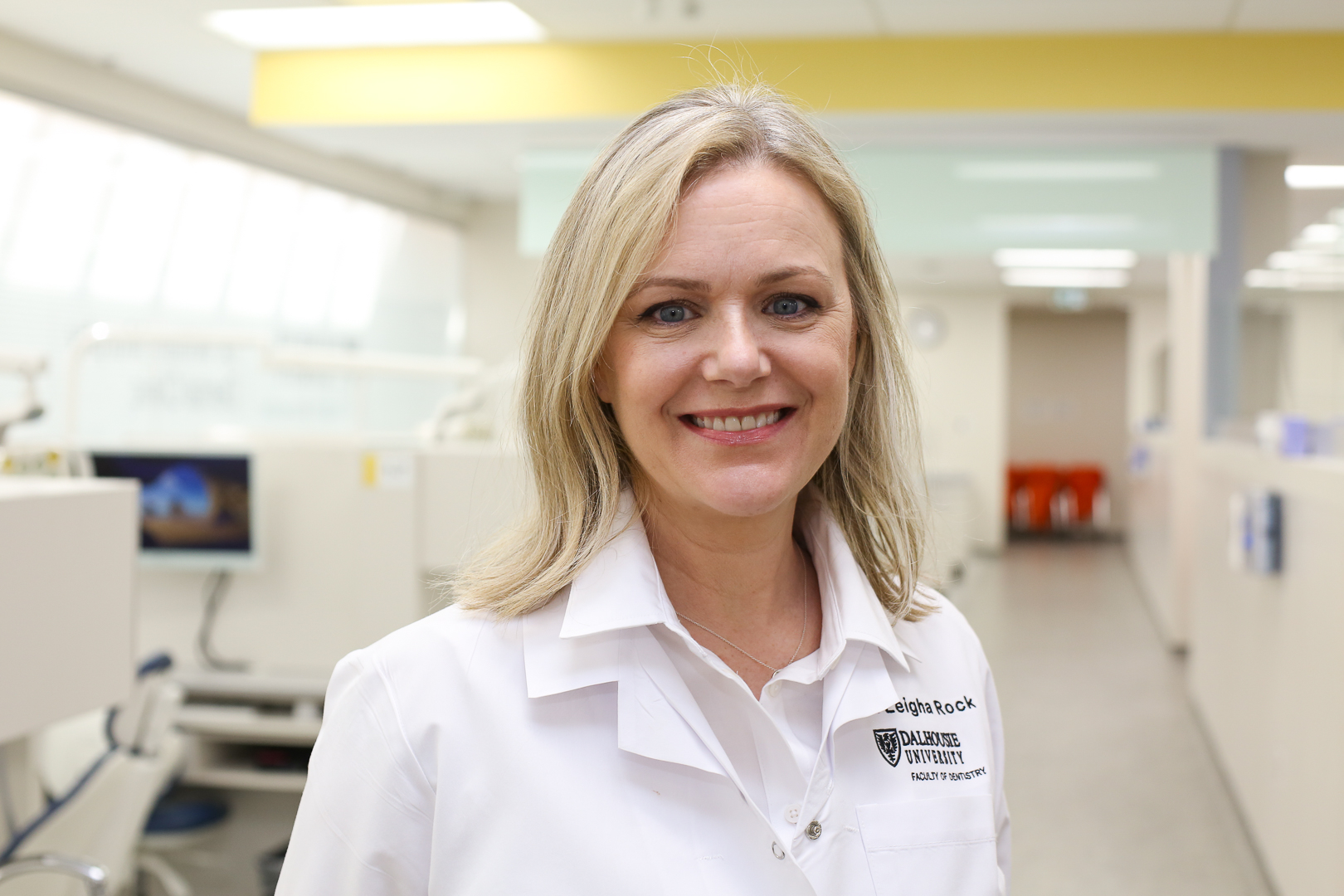
Leigha Rock, Ph.D., B.D.Sc. Photo credit: Bruce Bottomley.
Graduate studies—also at UBC Dentistry—followed, culminating in a Ph.D. in craniofacial studies and then a post-doctoral position at BC Cancer on integrative oncology and cancer control research. Since 2019, Dr. Rock has held the role of Director at Dalhousie Dentistry’s School of Dental Hygiene. She is also Associate Professor and leads her own research lab, RockLab. Dr. Rock readily admits that her educational and career path might appear a bit “eclectic.”
However, she says the core focus of her research has always been the same: the search for biomarkers to predict the transformation of oral pre-malignant lesions into cancer. This work is important because oral cancer is difficult to treat clinically, with surgery currently being the main form of treatment. Dr. Rock is currently running clinical trials on the use of Metformin to halt the malignant progression of oral precancer.
In her early years as a practicing dental hygienist, Dr. Rock was well placed to spot oral lesions and the early signs of dysplasia. “My interest in this area really started there,” she said.
Pre-cancerous changes are categorized into mild, moderate and high. Mild grade changes are treated with surveillance with surgery required for those in the high category, explained Dr. Rock.
In the moderate category, around 15% of the lesions progress to cancer. The difficulty is deciding which ones to treat, knowing that surgery can be damaging and life changing. “If we could figure out the difference between those lesions that progress and those that don’t,” says Dr. Rock, “that would truly inform clinical care in terms of how aggressive we should be with this group.”
In her research, Dr. Rock has studied many different risk predictors and biomarkers. Now, she is focused on the microbiome as a potential predictor, particularly its bacteria. Dr. Rock has examined the swabbed cells of precancerous lesions that were collected up to two decades ago and stored in a biobank, some of which developed cancer and some of which did not.
What she learned is that the bacteria in the microbiome influence the inflammatory pathways. It’s a significant discovery because it supports a growing idea in the literature about functional redundancy within bacteria. “That means that maybe it’s not a specific species or genre, but rather a group of them,” she said.
Dr. Rock’s next step is to put her new $600,000 CIHR catalyst grant into action. Her plan is to study the nearly 2500 saliva samples held in a federal government repository and map the antimicrobial-resistant genes in the oral cavity. It’s a project she believes will have a wide-ranging impact on the oral health research community and on public health.
More recently in August 2025, Dr. Rock was elected as one of five inaugural Emerging Leaders in Health Sciences in Canada.
Courtesy of Dalhousie University Faculty of Dentistry
Published on December 10, 2025