
MEMBER FOCUS: Dental Students Gain Enhanced Clinical Training Through New Orofacial Pain and Oral Medicine Rotation
MEMBER FOCUS: Dental Students Gain Enhanced Clinical Training Through New Orofacial Pain and Oral Medicine Rotation
The fall semester at the Virginia Commonwealth University School of Dentistry (VCU SOD) opened with a milestone as the VCU SOD Department of Oral Diagnostic Sciences celebrated the inaugural week of the Orofacial Pain and Oral Medicine (OFPOM) rotation. The experience gives dental students the opportunity to learn directly from departmental faculty and strengthen their confidence and understanding in this essential area of practice, and it was only the beginning of the new rotation.
The rotation was created as a result of the hard work of oral diagnostic sciences faculty Alexandra Howell Doss, D.M.D., Assistant Professor, Shawn McMahon, D.D.S., Associate Professor, and Leigh Griffin, D.D.S., Assistant Professor, along with the department’s faculty.
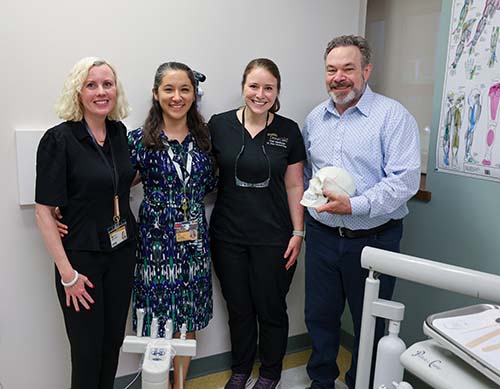
“While we’re based in Richmond, our patients come to us from all over Virginia,” said Dr. Doss. “However, the real long-term impact is in the dentists we’re sending out into the world. By training our students to spot these conditions early, they can better educate their future patients on what’s going on and what to expect. Over time, we hope that the standard of care across our whole region will be elevated so general dentists can handle more of these cases directly and know exactly when it’s time to send a patient to a specialist.”
Dr. Doss’ goals with the program are to take the “mystery” out of complex oral health issues and give students confidence when they encounter the unexpected.
“We want them to leave with a practical mindset for solving tricky diagnostic puzzles and a real appreciation for how deeply medicine and dentistry connect,” said Dr. Doss. “Even if they do not pursue a specialty in orofacial pain or oral medicine, we hope they develop more of a holistic perspective that increases the standard of care in whatever community they choose to serve in the future.”
Dr. McMahon described the goals of the rotation as threefold: to close the educational gap, strengthen access to care, and spark interest and build a pipeline for the two specialties.
“I want students to leave here feeling confident to recognize, diagnose and manage orofacial pain conditions and oral mucosal disease,” said Dr. McMahon. “I also want them making sound management decisions, writing notes and referral letters that actually communicate, and knowing exactly when to treat, biopsy or refer out to our interdisciplinary partners. We also are hoping to spark early interest that inspires students to pursue residency training in orofacial pain and oral medicine.”
Orofacial pain and oral medicine are the two most recently recognized dental specialties in the United States, according to Dr. McMahon. Both specialties earned American Dental Association recognition in 2020, a recognition that was in the works for decades. The Academy of Oral Medicine was established in 1945 and waited 75 years for formal specialty recognition. Now called the American Academy of Orofacial Pain, it published its first clinical guidelines in 1990 and refined them for 30 years before recognition finally came.
“These are old, hard-won fields that have only just become official, and dental education is still catching up,” said Dr. McMahon. “Our students have often asked us for more hands-on clinical training and an opportunity to apply what they learn in the classroom and in lectures to patient care while still in dental school.”
The need for more orofacial pain specialists and dentists with training in the field is evident; the landmark Orofacial Pain: Prospective Evaluation and Risk Assessment (OPPERA) study estimated that roughly 10%-15% of the adult population experience chronic orofacial pain. In contrast, there are fewer than 350 active diplomates board-certified by the American Board of Orofacial Pain in the United States.
This need, combined with students’ enthusiasm to learn, inspired Drs. Doss and McMahon to design this new OFPOM rotation.
“The heart of it is teaching students the sequence that has to come before any diagnosis or treatment plan: a thorough interview followed by a comprehensive, systematic clinical exam,” said Dr. McMahon. “You have to slow down, take a careful medical and dental history, and work through the exam methodically before you reach for imaging or special tests.”
From there, students split their time across both specialties. On the pain side, they learn to use the biopsychosocial model—treating pain not as just a physical joint or muscle problem, but as a complex mix of biological, psychological and social factors. Through this lens, students learn to manage conditions like temporomandibular disorders, burning mouth syndrome, trigeminal neuralgia, persistent dentoalveolar pain and sleep issues, focusing mostly on conservative, nonsurgical care.
On the oral medicine side, students dig into oral mucosal lesions, salivary gland disorders, medically complex patient care and the oral manifestations of systemic and immune-mediated conditions—such as painful vesiculoerosive diseases. Students learn to stratify risk rather than lump every red or white patch together.
In addition to the field-specific skills the students acquire, they also sharpen their knowledge in writing referrals and triage judgment that can be applied to all patient care.
“Dr. McMahon and I have run this clinic for years, but we recently shifted it to a hands-on teaching clinic,” explained Dr. Doss. “Now, a dental student does the initial exam first, puts together their own thoughts on the diagnosis and treatment plan and then brings the case to Dr. McMahon or me to review together. It gives them space to think like an independent provider while still having us right there to back them up.”
The first cohort of learners to complete this new clinical experience included third- and fourth-year dental students Armando Del Sol, Emmy Whitehead, Maria Lawandi, David Dinh, Tali Raichelson and Ana Isis Cesario. The students worked closely with facilitators Drs. Doss, McMahon and Griffin during the week-long rotation.
For Ms. Raichelson, it was an opportunity to become a more comprehensive provider. She recalled learning not only about clinical skills in orofacial pain, but also how to better communicate with and understand the needs of patients.
“Drs. Doss and McMahon truly embody what it means to be an empathetic and thorough provider,” said Ms. Raichelson. “They are honest with their patients in expectations and outcomes while still ensuring the patient feels heard. They were great at demonstrating patient workflow and how to best adapt treatment appropriately.”
Mr. Del Sol said that the experience taught him that dentistry is about more than just teeth. He learned the importance of looking for and recognizing symptoms that go beyond the ordinary.
“It really opened my eyes to how important it is to conduct a thorough and proper examination on every patient and to ask the right follow-up questions so we can understand the patient's concerns and help them to the best of our abilities,” said Mr. Del Sol. “I have a better understanding of how to conduct thorough head and neck examinations, consider possible management strategies for various orofacial pain conditions, and recognize when a patient's presentation may warrant further evaluation or referral.”
In addition to clinical skills, Mr. Del Sol gained confidence in communication with patients, especially when discussing potentially upsetting topics.
“It is not only important to recognize the signs and know when to refer a patient to a specialist, but also to develop the communication skills necessary to discuss these findings with patients in a professional and compassionate manner,” said Mr. Del Sol. “Conversations involving potentially serious diagnoses or malignancies are not simple or straightforward, and I believe learning how to approach them appropriately is an important part of becoming a well-rounded clinician.”
The new rotation will continue throughout the year, with new students having the opportunity to explore orofacial pain and oral medicine each week. They walk away with newfound knowledge and skills to become better and more well-rounded clinicians, while patients will receive life-changing care.
Courtesy of Virginia Commonwealth University School of Dentistry
Published on November 11, 2026