
MEMBER FOCUS: When the Clues to an Unknown Identity Are Hidden Inside the Mouth
MEMBER FOCUS: When the Clues to an Unknown Identity Are Hidden Inside the Mouth
If you’ve ever watched a “CSI” television show, you may be familiar with scenes showing a medical examiner trying to identify a body. You may have even heard the medical examiner say something like, “Aha! The third molar matches the dental records!” In real life, if anyone said that, it would be a specially trained dentist, called a forensic odontologist—like Melissa Newman, D.D.M.
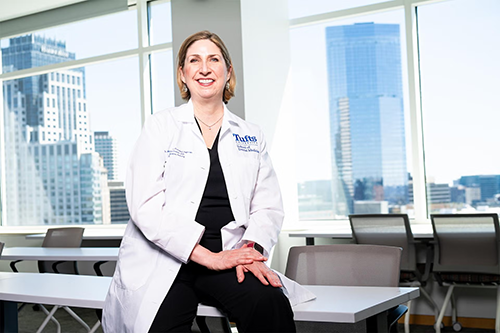
In her years as a dentist, forensic dentistry expert Dr. Melissa Newman has developed skills to see nuances in the oral cavity. “I can put them to use in this different kind of dental exam,” she said. Photo: Alonso Nichols.
Dr. Newman joined the faculty of Tufts University School of Dental Medicine (TUSDM) in 2025 as the Joan Viantha Qureshi, D85, Professor in Forensic Dentistry. This latest chapter of her professional life builds on her long-simmering interest in forensic dentistry, which uses the tools of dentistry to restore identity to victims of crimes, disasters and accidents.
Dr. Newman finds the field to be just as intriguing as she always thought she would. “As a dentist, I’ve developed a lot of skills with seeing nuances in the oral cavity, and I can put them to use in this different kind of dental exam,” she said.
While the work can be emotionally difficult, she said it’s ultimately fulfilling. “I was looking for connection and a sense of meaning,” she said. “With the forensics, it’s a community service we’re giving to the families of the people we help identify.”
Identification Through Dentistry
The use of dental evidence to confirm identities dates back to antiquity. In modern times, it has helped solve any number of mysterious murders and missing-persons cases, as well as identify individuals in the aftermath of mass casualties, such as 9/11 and the Indian Ocean tsunami in 2004. Longtime TUSDM Professor Stanley Schwartz was among the first modern specialists who rose to prominence after identifying dozens of victims of a plane crash at Boston’s Logan airport in 1973.
Dr. Newman is a member of the all-volunteer New Hampshire Dental ID Team. She and other team members answer the call when the New Hampshire medical examiner needs assistance. “When we have an idea of who the person may be as well as their dental records, we are able to confirm their identity without having to wait for DNA or other lab tests,” she said. “It’s good for the family that’s grieving if they can get a quicker answer.”
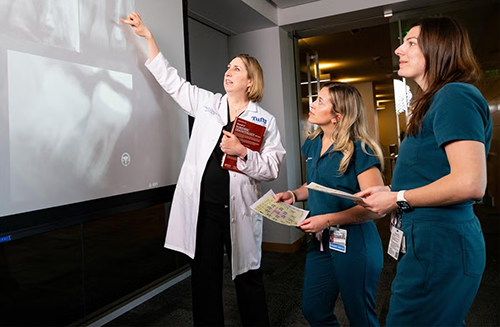
Dr. Newman meets with Alicia de Fabrique and Katelyn Hunter, dental student members of the newly created Forensic Dentistry Club at Tufts. Photo: Alonso Nichols.
To identify a body, forensic odontologists examine the teeth, the jaw, the configuration of sinus cavities and even the pattern of ridges on the roof of the mouth. They compare their findings to any dental radiographs, photos and orthodontic molds that are available.
More recently, Dr. Newman and other members of the New Hampshire Dental ID Team have been working to help solve cold cases. For example, under the direction of the New Hampshire medical examiner, the team recently created dental records that include photographs and radiographs of the remains of a person found in northern New Hampshire in the 1970s. They uploaded these records into the database NamUs, the National Missing and Unidentified Persons System. Several police departments have seen the records and thought they might be a match to a missing person in their files.
Those departments sent the dental records they had on file, and the ID team compared those to the records they produced more recently. “A lot of times, the records are old and hard to read—they may be handwritten in cursive and not very detailed,” said Dr. Newman. “We have to work with what we have.” Unfortunately, the team has not yet found a match in that case, but Newman hopes it will eventually.
From Hygienist to Teacher
Although Dr. Newman wanted to be a dentist as a child, she took a long and winding road to get there. After high school, she decided to train and work as a dental hygienist for a few years before pursuing dental school. She liked the hygiene work so much that a few years turned into 16 years. She might still be a dental hygienist today except for the encouragement she received from one of her patients, whose own son had recently graduated from dental school. “He inspired me to go back to school in my 30s and do what I’d always wanted to do,” she said.
After earning an undergraduate degree in biology from California State University, Northridge, she attended TUSDM, graduating in 2008. After that, she ran her own dentistry practice in southern New Hampshire for 15 years.
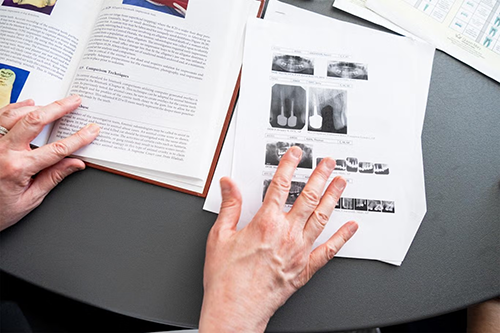
Dr. Newman goes over some of the techniques she uses to help identify victims of crimes, disasters and accidents. Photo: Alonso Nichols.
Her long-standing interest in dental forensics was set aflame when she attended the 2022 Sarah Umeko Qureshi Memorial Lecture in Forensic Dentistry and the Forensic Sciences at TUSDM. The featured speaker was Lena Karkalas, D.D.S., the only dentist in Rhode Island accredited by the American Board of Forensic Odontology (ABFO). Dr. Karkalas provided the inspiration and guidance that led Dr. Newman to enroll in the Forensic Dentistry program at McGill University Faculty of Dental Medicine and Oral Health Sciences in Montréal, Québec, Canada. Dr. Newman finished the course in 2024 and is now working on the other requirements to become board-certified through the ABFO.
“I had a great experience [as a student] at Tufts and always thought that someday I’d like to come back and teach,” she said. As Assistant Professor in the TUSDM Department of Comprehensive Care, Dr. Newman is developing a forensic dentistry curriculum, doing research and managing the Qureshi Memorial Lecture, which takes place each fall. For her research, Dr. Newman wants to work on improving missing-person databases, through better integration and centralization.
Dr. Newman is also the advisor for the brand-new Forensic Dentistry Club, started by third-year dental student Alicia de Fabrique. Ms. De Fabrique said she hopes to line up guest speakers from a variety of fields—forensics, forensic odontology, even anthropology and bioarcheology, noting that tooth wear is an important clue to the diets of prehistorical people. She also hopes to present famous case studies and do activities where she and her peers could ID mock disaster victims using dental records. “Having the club tie into the curriculum that Dr. Newman is designing will be a great way to get people more involved,” she said.
Dr. Newman spends two days a week at Tufts and practices as an associate dentist in New Hampshire two days a week. “I always thought I would like to teach later in my career, and the Qureshi endowed professorship helped me realize my dream,” she said. “I had a busy, busy private practice and I had to cut back a little, but I’m ready for the change. It’s been a revitalizing time for me and my career.”
Dr. Newman likes to watch “CSI” shows herself but said they aren’t always completely realistic. “I find flaws with it on TV,” she said. “Some things are close, but usually not quite the way it’s really done. And they solve everything in 45 minutes.”
Courtesy of Tufts University School of Dental Medicine
Published June 10, 2026