
Session Daily | Tuesday, March 24
Closing Plenary
At the Tuesday Plenary, Learn How to Survive a Crisis
The Tuesday Plenary, “Radical Recovery: How Great Leaders Prepare for and Come Back From Tough Times” from 10:00 – 11:15 a.m. in Palais des congrès de Montréal, will feature Anton Gunn, national leadership expert and former Advisor to President Barack Obama. Mr. Gunn made history at the beginning of his career as the first African American elected to the South Carolina Legislature from his district.
Today, he is the CEO of 937 Strategy Group and works with organizations globally to develop socially conscious leadership and stronger leaders. Mr. Gunn equips organizations with the skills to navigate crises, strengthen culture and lead with confidence. He teaches that any team can excel in adversity by applying the core principles of high-impact leadership.
After the plenary, attendees should be able to identify and describe disruptive environments, recognize and employ the right mindset during uncertain times, build resilient teams that are prepared for adversity and respond to the impact of the crisis (i.e., do not react to the circumstances).
Tapestry Table
Tapestry Table Explores the Legacy of Henrietta Lacks
At the ADEA Tapestry Table on Monday, “Immortal Cells, Enduring Lessons: The Lacks Family, Ethics and Oral Health Innovation,” the topics of informed consent, equity and dignity in health care and honoring the memory of Henrietta Lacks, the woman whose life was the subject of Rebecca Skloot’s bestselling book, The Immortal Life of Henrietta Lacks, were discussed at length.
During the event, which was sponsored by Haleon, Sonya G. Smith, J.D., Ed.D., M.Ed., M.A., ADEA Chief Operating Officer and Chief of Staff, interviewed Henrietta Lack’s great-granddaughter, Veronica Robinson, and her grandson, David Lacks, Jr., to give insight into Henrietta’s life and legacy. Henrietta’s HeLa cells—arguably the most important human cell line in scientific history—have been used for everything from discovering treatments for polio to establishing the connection between HPV and cancer to the testing potential treatments for oral squamous cell carcinoma.
“I was thinking that if Henrietta was here today, she would say, ‘Chile, my cells did what?’” Robinson said.
But the family acknowledged a darker legacy of Henrietta’s contributions that still impacts medicine and health care today: That for many decades, her cells were used for research and treatment developments without her consent.
“Patients expect that they will be treated with respect and trust. That didn’t happen with Henrietta,” Dr. Smith said.
A Legacy Long Hidden
Though Henrietta has had a huge impact on modern medicine and research development, for many years her influence was largely unknown—including by her own family. Many of them weren’t told she’d been treated by The Johns Hopkins Hospital in Baltimore, MD, for cervical cancer or that she eventually succumbed to the disease, according to Lacks and Robinson.
“We didn’t know anything about our grandmother. The older generation like my grandfather didn’t believe in talking about the dead,” Lacks said.
“In our family, children are seen not heard,” Robinson said. “We had to stand at the top of the stairs during adult conversations to hear what was happening.”
After Skloot asked to interview the family and later wrote her book, their knowledge about their grandmother and great-grandmother quickly expanded. “Her cells have been around the world and outer space and places we just couldn’t imagine,” Lacks said.
Dr. Smith noted that health professionals’ knowledge of all Henrietta’s contributions may also be limited even though her story is much more widely circulated. She said she spoke to a dentist who told her, “’We only talked about her in bioethics. We don’t talk about her beyond that.’”
The Limits of Informed Consent
There have been attempts to right past wrongs to Henrietta and her family. Robinson said that the family now works with the National Institutes of Health as voting members on a committee that can review and approve the use of HeLa cells for new medical research and treatments. The family has also settled out of court with some companies who profited from their research using the HeLa cells.
“The lawsuits are bigger than Henrietta. It’s about a community of people that never received their just due,” Robinson said.
Robinson pointed to other examples of underrepresented communities who were taken advantage of by the medical establishment, such as the “Father of Gynecology” J. Marion Sims who tested on enslaved women, the Tuskegee Syphilis Study on African Americans that spanned 40 years, and the polio experiments on Indigenous populations in Canada from the 1930s to 1970s. In all cases, participants did not give informed consent.
But even now, in 2026, Lacks pointed out that “informed consent” still has its limits, despite there being some progress since the days his grandmother received treatment for cervical cancer.
“When you walk into a medical facility or hospital, you just want to be healed,” Lacks said. “You aren’t checking every form and can’t understand everything you read.”
Henrietta’s family also noted that patients still can’t be completely sure how their biomaterial is used after treatment.
“Once tissue is removed from the body, it’s considered medical waste,” Lacks said. “It’s no longer yours. It can be used for medical testing.”
But he said that fact doesn’t sit well with him. “I feel like it still has your information,” Lacks said. “It has your DNA. It’s still yours.”
“I think if something came from your body, you should know what’s being done with it,” Robinson said. “You and your family should be able to profit from it or get treatment from it.”
Showing Respect and Giving Trust
The Lacks family said they hope the lessons that health professions take from Henrietta’s life and HeLa cells go beyond research and treatments—mainly, to treat patients with respect and to be worthy of the trust patients give to the health professionals who treat them.
“We can’t have trust without transparency,” Robinson said. “Treat them not just as a subject, but as partners.”
Sunday Recap
Opening Plenary Speaker Shares Ways to Find the Right Mindset in Challenging, Unprecedented Times
During the Opening Plenary on Sunday, featured speaker Cy Wakeman, Founder and CEO of Reality-based Leadership, TED speaker and NY Times bestselling author, shared how leaders can modernize their leadership style to meet the needs of the 21st century during her discussion, “Leading in Challenging, Unprecedented Times — Building Bridges & Helping Hope Make a Comeback.”
“She brings 25 years of HR expertise on how to diffuse drama in the workplace,” said ADEA Chair of the Board of Directors Todd V. Ester, D.D.S., M.A., during his introduction to Wakeman’s presentation.
He said Wakeman would “share her no ego approach with us” for leadership “so we can learn to love people up.”
“I want you to modernize your leadership philosophies so you can get out of the ‘80s,” Wakeman said.
She noted that “the leader’s role is no longer to inspire and motivate but to eliminate drama.”
Dealing with a “Unpreferred Reality”
Wakeman pointed out that social scientists use various tools to get a feel for people’s mindsets. One method is word mapping and “for the last five years, the top word has been ‘unprecedented.’ So, do you know what that means? We’re stuck.”
Starting with the COVID shutdowns, our rapidly changing environment and social landscape have been filled with triggers that Wakeman said has led to rampant disassociation. The American Psychological Association defines dissociation as “a defense mechanism in which conflicting impulses are kept apart, or threatening ideas and feelings are separated from the rest of the psyche.”
Wakeman said we do not have to be “traumatized” by these unprecedented times. “That’s not our only option,” she said. “We can emerge evolved from these experiences.”
She said those who emerged for the better, had people in their lives who “held space for people” and “didn’t use toxic positivity.” They validated people’s experiences, but also when something traumatic happened didn’t allow them to stay stuck in negativity.
“Just think of this as an unpreferred reality,” she said.
Defuse the Drama in the Workplace
During her presentation, Wakeman provided real-life examples of how she carefully navigated leadership in hospital and HR management so that she wasn’t a “fixer” who tried to fix the problem for her employees or a “polluter” who would wallow and vent with them, but a “regulator” and “integrator” who helped employees to self-reflect and feel as if they had some control in chaotic situations.
“If we don’t integrate,” Wakeman said, “people keep thinking they’re victims and things are just happening to them.”
She encouraged leaders to self-reflect and encourage their employees to ask questions like, “What can I do to help? What do I know for sure? What can I do to add value? What would great look like?”
“Self-reflection is the best drama diffuser,” Wakeman said.
Knowing the Difference Between Reality vs. Our Story
Wakeman said modern leaders are translators who “get people to stop judging and start helping.” Your job as a leader is to “manage the energy for your people,” she said.
“I’m not saying your feelings aren’t real,” Wakeman said, but the stress we suffer is based on our view of the situation we’re living through.
“Our stress comes from our story, not from our reality,” she said. “Reality is not why you’re suffering. It’s not the reason why you can’t succeed. It is the circumstances in which you could succeed if you believe it’s possible, Wakeman said."
Poster Winners
Winners of the 2026 Student Poster Competition Announced
Congratulations to the Winners of the ADEA Student Poster competition.
First Place
PO-029. Factors Influencing Interpretation Difficulty of Pediatric Caries on Bitewing Images
Lauren Greco, B.H.Sc. (Hons)
University of Toronto Faculty of Dentistry
Second Place
PO-012. Building Healthier Communities: School-based Oral Health Promotion Through Teacher Empowerment
Gabriella Ward
UT Health San Antonio School of Dentistry
Third Place
PO-021. Effects of Faculty Standardization on Healthcare Student Performance: A Systematic Review
Rebecca Feldman
NYU College of Dentistry
#ADEA2027
See You in Chicago!
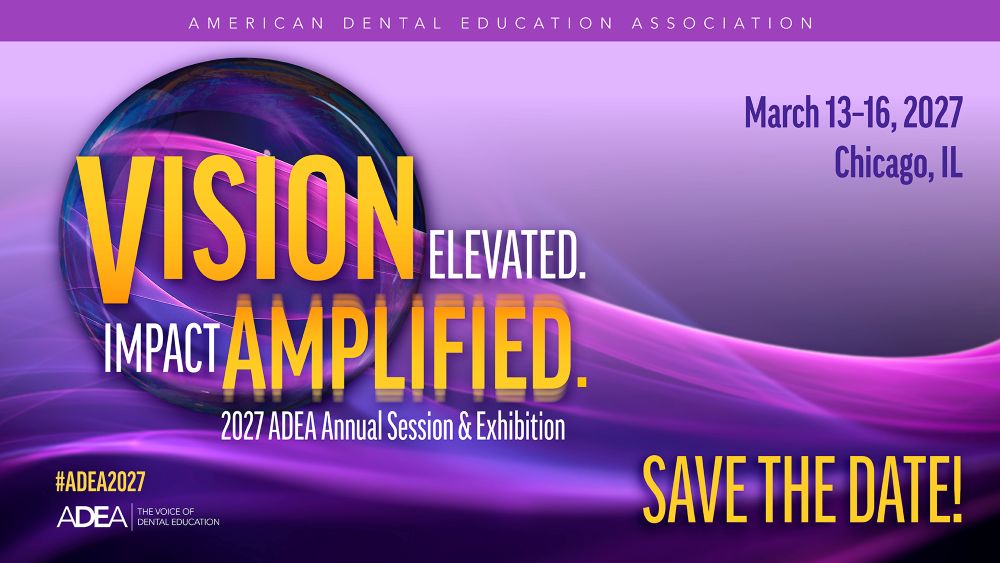
Start planning now for the 2027 ADEA Annual Session & Exhibition, which will take place March 13–16, 2027, in Chicago. This meaningful and empowering conference celebrates ADEA’s shared vision and its commitment to shaping a transformational future for oral health education, which is epitomized in the 2027 ADEA Annual Session & Exhibition theme, “Vision Elevated, Impact Amplified.”
The theme is powerfully reflected in the leadership of Cherae M. Farmer-Dixon, D.D.S., M.S.P.H., M.B.A., Chair of the ADEA Board of Directors. A leader whose career has been shaped by breaking barriers and advancing opportunity, Dr. Farmer-Dixon exemplifies what it means to elevate purpose into action. Her historic role as the first African-American woman to serve as Chair of the ADEA Board of Directors underscores how principled leadership can expand what is possible—not only for individuals, but for the profession as a whole.
Visit adea.org/2027 throughout the year to learn more about 2027 ADEA Annual Session & Exhibition programming and events and to find important dates such as the Call for Programs, registration deadlines, and so forth.
Event Highlight
Thank You for Joining Us!

At Sunday's Discourse & Dessert, honoring the late Dr. Jeanne C. Sinkford, ADEA President and CEO Dr. Karen West engages in a conversation with Canadian actor Tantoo Cardinal.

Dr. Jeanne C. Sinkford's family members pose with Dr. Karen P. West, ADEA President and CEO, and ADEA Chair of the Board members in front of a Proclamation Honoring the Life, Legacy and Contributions of Dr. Sinkford.

ADEA scholarship awardees were acknowledged at the Monday Plenary which also featured an ADEA Tapestry Table discussion with The Lacks family.

Attendees line up to take photos at the ADEA Headshot Cafe in the Exhibit Hall.
I-516 AC Establishing the Continent of Africa's Dental Education Association
Missed the #ADEA2026 session on Establishing the Continent of Africa's Dental Education Association?
The full livestream recording is now available.
Registration Booth Hours
- March 24 | 8:00 a.m. – 2:00 p.m.
The registration booth is in Viger Hall on Level 2, Palais des Congrès de Montréal.