
Besides a few exceptions, the majority of dental students possess a bachelor’s degree before they enter dental school.
Frequently Asked Questions
2026-27 FAQs
Letters of Evaluation
How do the letters of evaluation (also referred to as evaluations and LOEs) work in ADEA AADSAS®?
ADEA AADSAS collects letters of evaluation, also called letters of recommendation, for all applicants. Letters are collected electronically. Applicants can either submit one committee/composite letter and up to three individual letters or four individual letters. Interfolio letters are also accepted.
For more details, visit the ADEA AADSAS Help Center.
How many ADEA AADSAS evaluations are required?
Applicants can submit four evaluations. They have the option to submit one committee/composite letter and up to three individual letters or four individual letters. A committee letter is many authors of one letter, and a composite letter is multiple letters in one file.
Can applicants submit evaluations via Interfolio?
Yes, evaluations stored by Interfolio can be submitted to ADEA AADSAS. Applicants can include a combination of evaluations from Interfolio and directly via ADEA AADSAS. Evaluations submitted by Interfolio, though, will not include responses to the new evaluation questions.
For more details, see additional FAQs below or visit Interfolio.
What is the process of submitting an evaluation in ADEA AADSAS?
Applicants provide the name and contact information of an evaluator in their ADEA AADSAS application. The evaluator receives an email from Liaison Letters and accepts or declines the invitation. If accepted, they complete the evaluation and digitally upload their letter. The status of evaluations requested in ADEA AADSAS can be monitored in the “Check status” tab of the applicant portal. The application can be submitted before evaluations are received.
For more details, visit the ADEA AADSAS Help Center.
What is the evaluation process for reapplicants?
Reapplicants must request new letters for each cycle.
2026–27 Evaluation Changes
Why are questions being added to the ADEA AADSAS evaluation process?
Dental schools go through a continuous improvement process to (1) obtain quality information to assist in making admissions decisions and (2) improve the process for applicants. The new questions were added to provide dental school admissions committees with a way to more comprehensively evaluate applicant characteristics.
What changes are being made to the ADEA AADSAS evaluation process?
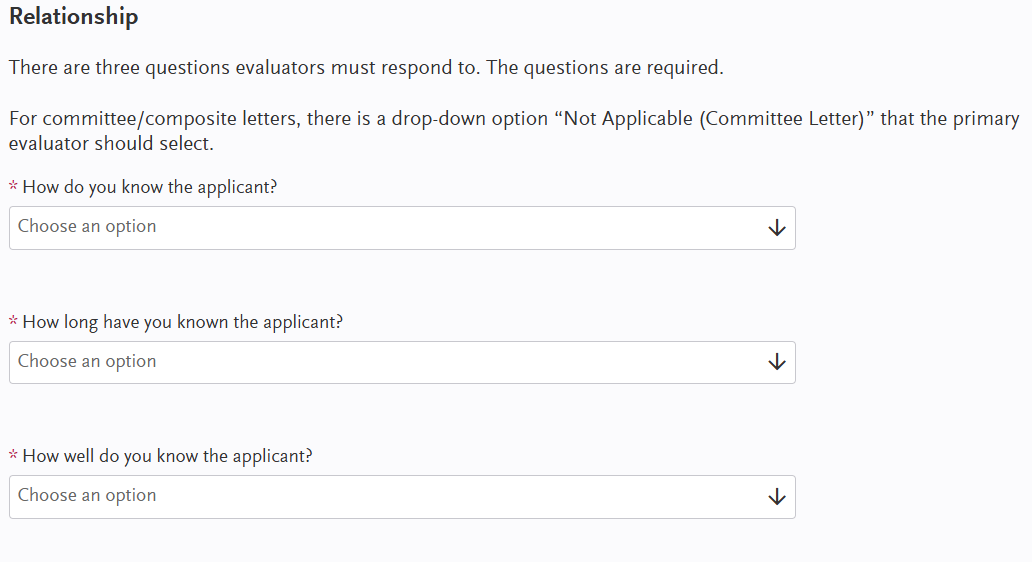
In addition to uploading the evaluation letter, evaluators will be asked to respond to 13 new relationship and characteristic questions being added in the Liaison Letters portal for the 2026–27 cycle. Responses or ratings for all questions are required, while comments are optional. Responses will be shown as qualitative data and will not have an assigned numeric value.
Additional details, including drop-down options, are available in the ADEA AADSAS Help Center.
- Relationship questions
- Characteristic questions
- Critical thinking
- Didactic knowledge
- Integrity
- Interpersonal skills
- Maturity
- Motivation to pursue dentistry
- Organizational skills
- Professional demeanor
- Reaction to criticism
- Self-awareness
For example: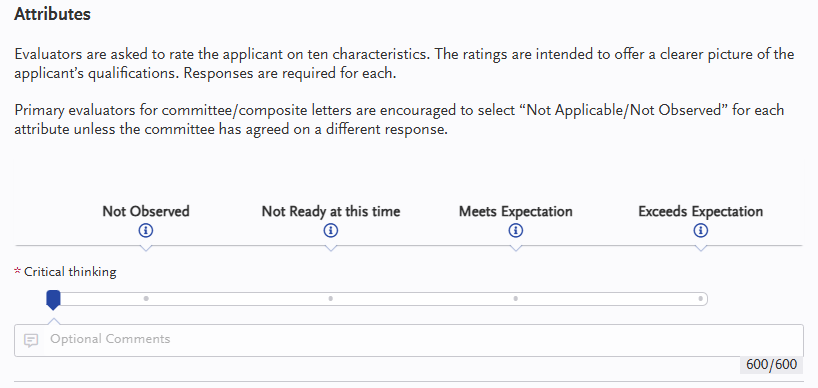
Who decided to add additional questions to the ADEA AADSAS evaluations?
The questions were added by ADEA AADSAS Advisory Group, which is composed of dental school admissions officers, a prehealth advisor, a dental student and ADEA staff.
Is it true that ADEA includes relationship and characteristic questions in other centralized application service evaluations?
Yes, the oral health education community has used similar questions in the centralized application service for dental students applying to residency (ADEA PASS® [Postdoctoral Application Support Service]); the relationship and characteristic questions have been utilized by evaluators for over 10 years. The new questions were also added to ADEA CAAPID® (Centralized Application Service for Advanced Standing Programs for International Dentists) in the 2026–27 cycle.
How will the new questions function with a committee/composite letter?
Committee (many authors of one letter) and composite (multiple letters in one file) letters are encouraged and the submission process will remain the same. The primary evaluator will receive an email with a link to the Liaison Letters portal, where they can accept the request, complete the evaluation form by responding to the questions and uploading the evaluation.
The primary evaluator will see the new questions. If the committee has agreed on responses and ratings, the primary evaluator can respond accordingly; if not, the primary evaluator should select “NA/Not Observed” for all questions. Committees may also choose to address some or all 10 characteristics as part of their evaluation narrative.
How will “NA/Not Observed” responses in evaluations be used by dental school admissions committees?
As with all parts of the application, each school will use the evaluation responses and ratings differently. Admissions committees will continue to use school-specific admissions processes that fit each school’s mission.
Based on historical data, the dental school admissions community anticipates many letters will have all “NA/Not Observed” responses, especially as the ADEA AADSAS Advisory Group recommends this action for committee/composite letters and letters submitted via Interfolio. The dental community will continue to discuss use cases for the new evaluation data.
Should applicants be concerned if evaluations do not have responses and ratings to the new questions?
Applicants likely should not be overly concerned. Just as some (not all) applications include committee/composite evaluations, some evaluations will include responses to the new questions. Dental school admissions committees account for differences in evaluations.
Will the new evaluation questions be the same for future ADEA AADSAS cycles?
Changes to future application cycles have not yet been decided. Dental schools go through a continuous improvement process, and the ADEA AADSAS Advisory Group will continually evaluate the new questions as well as other parts of the application.
Throughout the 2026–27 cycle, ADEA will provide ongoing opportunities for the dental school admissions community to discuss best practices about incorporating the new data into their application review processes.
Where is this information posted?
Advisors and applicants can view the evaluation information on ADEA GoDental and the ADEA AADSAS Help Center.
Interfolio
What is Interfolio and why do applicants use it?
Interfolio is a cloud-based information system for users to collect and store documents like letters of evaluation. Applicants use it to store evaluations months, sometimes years, ahead of an admissions cycle. Letter writers submit their evaluations to Interfolio, and then Interfolio submits them to ADEA AADSAS when requested.
Will Interfolio letters be accepted in ADEA AADSAS?
Yes, evaluations from Interfolio will continue to be accepted.
How will the new questions function with Interfolio letters?
Interfolio will complete the evaluation, including responding “NA/Not Observed” to relationship and characteristic questions and uploading the original evaluation. For evaluations submitted via Interfolio, the original letter writer does not see or respond to the new questions, nor do they need to be contacted to submit the evaluation to ADEA AADSAS.
Should applicants ask for letters to be submitted to ADEA AADSAS directly or to Interfolio?
Applicants can choose either service. Interfolio continues to be a beneficial service for applicants who wish to request letters for ADEA AADSAS before the application process opens; however, evaluations submitted through Interfolio will be marked “NA/Not Observed” for all relationship and characteristic questions.
For evaluations already submitted to Interfolio, will evaluators be able to respond to the new questions?
No, evaluators submitting a letter to Interfolio will not be able to see or respond to the new questions. Letters submitted via Interfolio will be marked “NA/Not Observed” for all relationship and characteristic questions by Interfolio. If the applicant prefers the letter writer to respond to the questions, the letter writer will need to submit a new letter through Liaison Letters, the digital evaluation service through ADEA AADSAS.
Are applicants or evaluators required to use Interfolio?
No, it is not a requirement to submit ADEA AADSAS evaluations using Interfolio. Letters can be submitted directly through Liaison Letters, the digital evaluation service provided by ADEA AADSAS. Evaluations submitted through Interfolio will be marked “NA/Not Observed” for all relationship and characteristic questions.
General FAQs
What does a dentist do?
A dentist...
- Evaluates the overall health of their patients while advising them about oral health and disease prevention.
- Performs clinical procedures, such as exams, fillings, crowns, implants, extractions and corrective surgeries.
- Identifies, diagnoses and treats oral conditions.
- Performs general dentistry or practices in one of twelve dental specialties.
What is the difference between a D.D.S. and a D.M.D.?
The simple answer is nothing. Both D.D.S. and D.M.D. mean the same thing—the dentist graduated from an accredited dental school. The D.D.S. (Doctor of Dental Surgery) and D.M.D. (Doctor of Dental Medicine) are the same degrees. D.D.S. and D.M.D. dentists both receive the same education and both degrees use the same curriculum requirements set by the American Dental Association (ADA). It’s up to each individual university to determine which degree is awarded.
How much does a dentist earn?
Though incomes vary across the United States and depend on the type of practice, the ADA Health Policy Institute reports in its most recent survey (2023 Survey of Dental Practice) that the 2022 average net income for a private general practitioner who owned all or part of his or her practice was $218,220. For dental specialists, it was $335,920.
What are the dental specialties?
There are 12 recognized dental specialty options: Dental Anesthesiology, Dental Public Health, Endondontics, Oral and Maxillofacial Pathology, Oral and Maxillofacial Radiology, Oral and Maxillofacial Surgery, Orthodontics and Dentofacial Orthopedics, Periodontics, Pediatric Dentistry, Prosthodontics, Oral Medicine and Oral Pain. Learn more about each advanced dental education program in our Career options section.
What is the best major for dental school?
Many students interested in going to dental school are under the impression that they have to major in biology or some branch of science to be accepted to dental school. This is an incorrect assumption. A specific undergraduate major is not required for acceptance to dental school; however, a good foundation in the sciences is required.
Applicants with a well-rounded education, a variety of interests and personal experiences are ideal candidates and are encouraged to choose a major where they can demonstrate strong academic performance while focusing on developing a strong background in the sciences. Many programs also encourage students to take courses in social sciences and many dental schools have accepted students with majors in music, art history, engineering, math, humanities and sports administration, to name a few. Learn more in our Preparing for dental school section.
What are the major factors in dental school admissions?
Dental schools consider many factors when deciding which applicants to accept into their programs. Many schools use a holistic review, which includes biographical and demographic information along with GPAs, test (DAT) scores and community service, to name a few.
We all hear about the importance of good grades and test scores, but most successful candidates for admission not only demonstrate academic potential, but also show through their actions and experiences that they are motivated, compassionate and have the potential to be caring, ethical health care providers. Learn more in our Application process section.
Why can’t I find a ranked list of dental schools?
There is no official listing or ranking of dental schools. There are privately owned, non-ADEA or non-ADA sanctioned publications that allegedly rank dental schools according to the quality of their programs. Both ADEA and the ADA advise dental school applicants to view these rankings with caution. The basis for these rankings is questionable, and those individuals who are most knowledgeable about dental education affirm the difficulty of establishing criteria for dental school rankings. ADEA and ADA recommend that applicants investigate on their own the relative merits of the dental schools they wish to attend.
What’s the minimum GPA I should have to apply to dental school?
The weight a dental school applicant’s GPA carries varies among dental schools and can, among other factors, be based on an individual school’s criteria and personal evaluation. While a certain GPA might be considered “strong” at one school, that same GPA could be considered “less strong” at another school. ADEA encourages predental and prehygiene students to contact schools directly regarding specific GPA criteria and discuss this with their prehealth advisors. It’s also important to remember that separate GPAs are recorded for your undergraduate coursework and your graduate coursework.